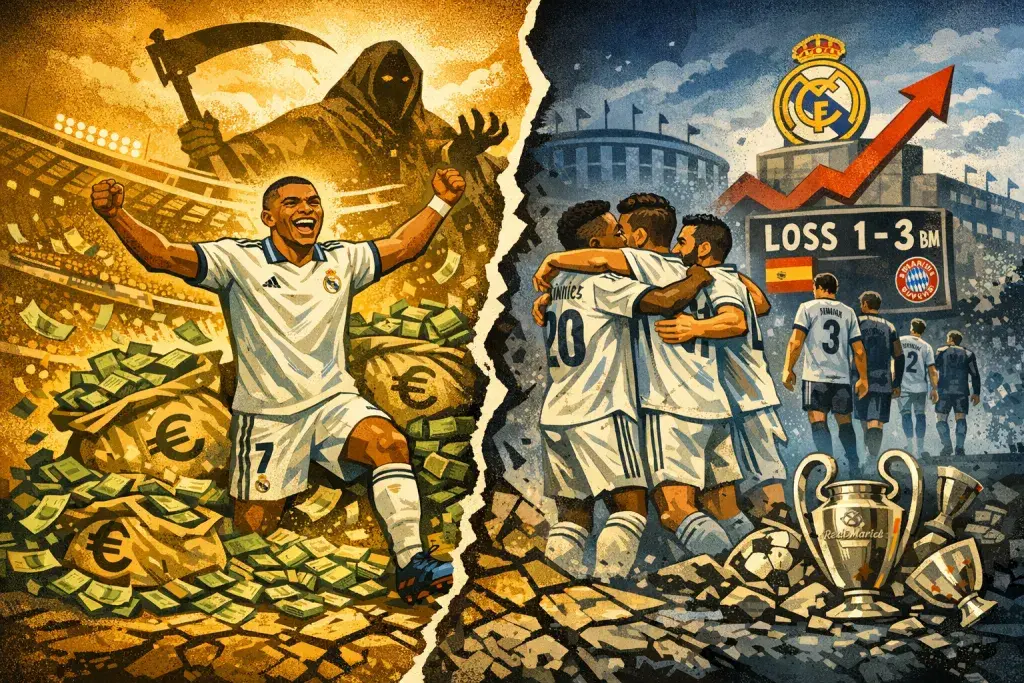
Eighty-three goals across 97 appearances is the kind of return that silences most critics before they open their mouths. Kylian Mbappe has produced those numbers at Real Madrid since arriving on a free transfer in the summer of 2024, and on the surface, the individual case for the move is airtight. Dig beneath the surface, however, and a more complicated — and troubling — picture emerges for one of European football's most storied institutions.
The Numbers Tell One Story. The Results Tell Another.
Mbappe's productivity has never been in doubt. His 39 contributions across all competitions in the current campaign place him second only to Bayern Munich's Harry Kane among forwards in Europe's five major divisions. His 2025-26 start was particularly electric: 27 goals before the winter break, including four in a single Champions League outing against Olympiacos and the opening effort in an October victory over Barcelona that briefly put Real five points clear at the summit of La Liga.
Yet Real Madrid have gone backwards. Barcelona now lead La Liga by nine points with seven rounds remaining, and Real face elimination from the Champions League after losing the first leg of their last-eight tie against Bayern Munich. In Mbappe's debut season, despite his haul of 44 goals — 31 in the domestic league alone — Real failed to win a single major honour. That 31-goal domestic return represented close to half of the club's entire league tally, a figure nine fewer than Real managed as a collective when they won the title the previous campaign. Individual brilliance and collective regression are rarely so neatly correlated.
When Mbappe Is Absent, Real Suddenly Function as a Unit
The most damning evidence against the current arrangement is not statistical. It is situational. Between late February and late March of this season, Real won six of seven fixtures, eliminating both Benfica and Manchester City from the Champions League and demolishing Elche in the domestic league. During that run, Mbappe was sidelined with a knee sprain. Manager Alvaro Arbeloa — promoted from the club's reserve setup after the dismissal of Xabi Alonso in January — shifted the structural approach, deploying a more compact 4-4-2 with Vinicius Junior and Brahim Diaz leading the attacking line.
The effect was immediate. Vinicius recovered the form that had made him a Ballon d'Or contender two years earlier. Federico Valverde found space to arrive late into dangerous areas. Aurelien Tchouameni provided the midfield solidity to allow those runs to happen without defensive exposure. Real, for that brief window, resembled a functioning collective rather than an elaborate support structure for a single performer. The moment Mbappe returned to full involvement, results deteriorated: one point collected from the subsequent two fixtures, including a defeat at Mallorca that represented the low point of the campaign.
A Pattern Established Long Before Madrid
None of this should have come as a surprise to those who followed Mbappe's years at Paris Saint-Germain. His time there was defined by extraordinary individual output and collective underachievement at the highest level. PSG won their first Champions League title in 2024-25, the season after his departure. The connection is causative, not coincidental. A more balanced collective emerged once the organisational logic of the squad was no longer subordinated to one player's preferences and positioning demands.
Former PSG manager Luis Enrique made his expectations plain before Mbappe left, invoking NBA legend Michael Jordan as a model for how elite performers set standards of effort that raise everyone around them. The point was specific: Jordan defended with the same ferocity he attacked. Mbappe has since acknowledged, on a public podcast appearance during the March international break, that he defends less than his colleagues — framing it not as a failing to address but as a trade-off he has accepted. "I'm a player who defends a little less than others, and sometimes that can be a problem," he said. "But I notice that when I do it, it really impacts the team." The self-awareness is notable. The absence of corrective intent is more so.
The Structural Problem Has No Easy Fix
Mbappe's recent form has deteriorated sharply. A single goal from his last seven outings, a shot conversion rate that has fallen from 25 percent earlier in the campaign to four percent, and a performance against Girona in which he surrendered possession 20 times while winning fewer than a quarter of his ground duels — these are the metrics of a forward who has lost confidence and cohesion simultaneously. The club has no credible alternative framework to deploy when he is ineffective: without him supplying the threat, there is no clear method; with him, the collective is constrained by the need to channel everything through his instincts.
That structural dependency is the central failure of Real Madrid's current approach. A forward who scores prolifically in favourable conditions but whose presence actively limits the options available to his organisation in adverse ones is not an asset without qualification. The question Real's hierarchy must eventually answer is whether the individual return — undeniable as it is — justifies the systemic cost. Barcelona, with a more distributed model of collective responsibility and pressing intensity, currently provide the most pointed possible answer to that question. They lead by nine points and they are not slowing down.