Thierry Henry has added his voice to a debate that surfaced after Morocco and Brazil played out a 1-1 draw in their 2026 FIFA World Cup group stage fixture, questioning the decision to name Vinicius Junior as Man of the Match. The former France international and Arsenal striker argued that the award failed to reflect how the match actually unfolded across 90 minutes, pointing instead to the influence of Morocco's 18-year-old midfielder Ayyoub Bouaddi as the more complete individual contribution on the night.
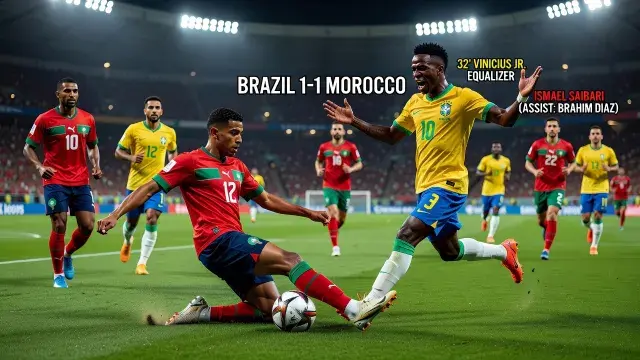
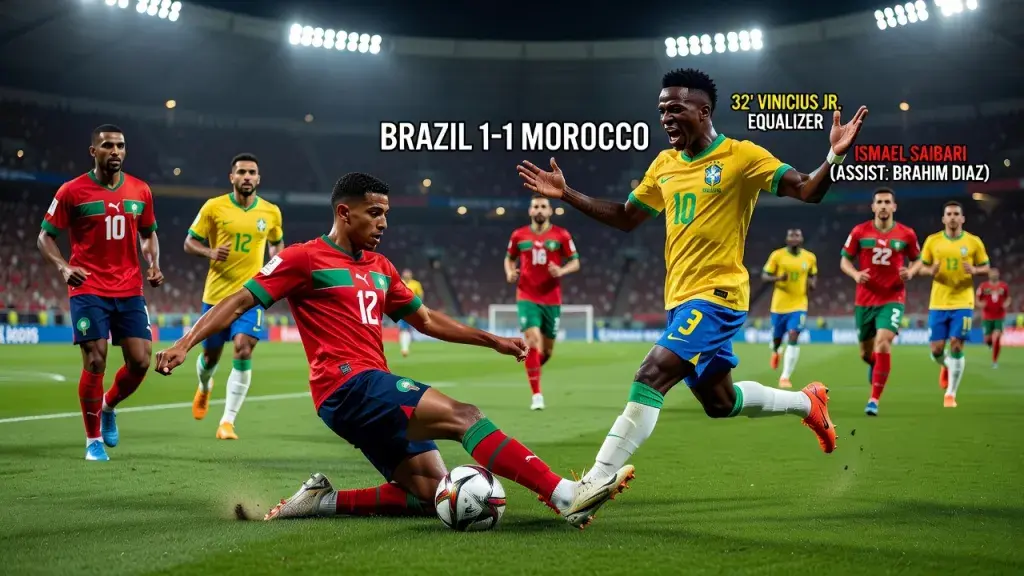
Vinicius was recognised after scoring Brazil's equaliser in the 32nd minute, a clinical finish that pulled the five-time world champions level following Ismael Saibari's opener - a goal set up by a sharp assist from Brahim Diaz in the 21st minute. While individual recognition in football often gravitates toward decisive attacking moments, Henry's argument echoed a broader conversation in the sport about how excellence is measured - one not entirely unlike the debates that arise across disciplines where performance metrics can diverge from headline moments, much as they do in cybersport live betting, where sustained match control often tells a different story than a single standout play.
Henry did not dispute the quality of Vinicius' goal. His case rested on the idea that Bouaddi's ability to shape Morocco's structure, maintain possession under pressure, and transition the ball effectively from defence into attack represented a more sustained and significant contribution to the contest as a whole.
Bouaddi Commands Midfield on World Cup Debut
For Bouaddi, this was a first competitive World Cup appearance, and the Lille midfielder responded to the occasion with the kind of performance that tends to accelerate a young player's reputation internationally. Against a Brazilian side that blends technical quality with physical intensity, the teenager controlled large phases of midfield, recorded the highest number of touches among Morocco's outfield players, and maintained a pass accuracy above 90 percent across the fixture.
His value was felt in the duels, in ball recoveries, and in the speed with which he moved Morocco up the pitch after winning possession. It was precisely that kind of work - unglamorous in isolation, decisive in aggregate - that Henry believed merited greater recognition. The Atlas Lions' early rhythm, which created the conditions for Saibari's opener, was built in no small part on Bouaddi's composure and positioning in the centre of the pitch.
Brazil Struggle to Impose Themselves Despite Vinicius Quality
Brazil's night was not without merit. Vinicius' equaliser was a reminder of why he remains one of the most dangerous attacking players in the world, and the Real Madrid forward's ability to produce in high-stakes moments is beyond question. But for stretches of this match, Brazil were forced to adapt to Morocco's compact defensive shape and disciplined pressing rather than dictating terms themselves.
The draw, while not a catastrophic result for Brazil, underlined that Morocco are not a team content to absorb pressure and hope. Under their structure, they pressed intelligently, broke forward with purpose, and took the lead against one of the tournament's pre-tournament favourites. That platform was constructed largely through the midfield - and Bouaddi was central to it.
A Wider Question About How Individual Awards Are Judged
Henry's broader point cuts to something the sport regularly wrestles with: the tendency of individual awards in major tournaments to default toward the most visually impactful moment rather than the most complete performance. A goal, particularly a decisive or aesthetically pleasing one, will almost always attract the attention of match officials and viewers alike. The midfielder who covers ground, wins the ball back, and keeps his team organised rarely produces a clip that loops on broadcast highlights.
For Morocco and African football more broadly, Bouaddi's emergence represents something meaningful regardless of the award. The Atlas Lions have consistently punched above their weight at recent major tournaments, and the development of technically gifted, tactically aware young players like Bouaddi points to a generation capable of sustaining that trajectory. At 18, making his World Cup debut against Brazil and performing at this level, the Lille midfielder has announced himself to an audience that extends well beyond club football - and Henry's remarks, whether or not one agrees with the underlying judgment, have only amplified that introduction.