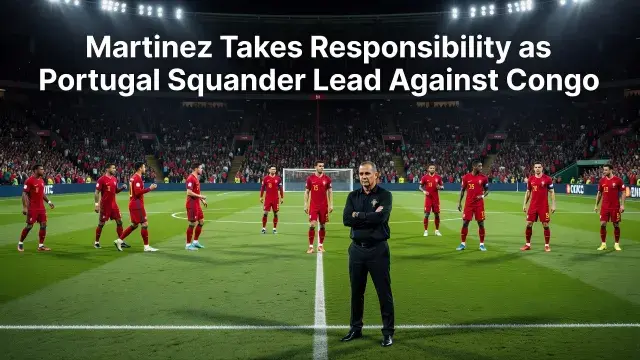
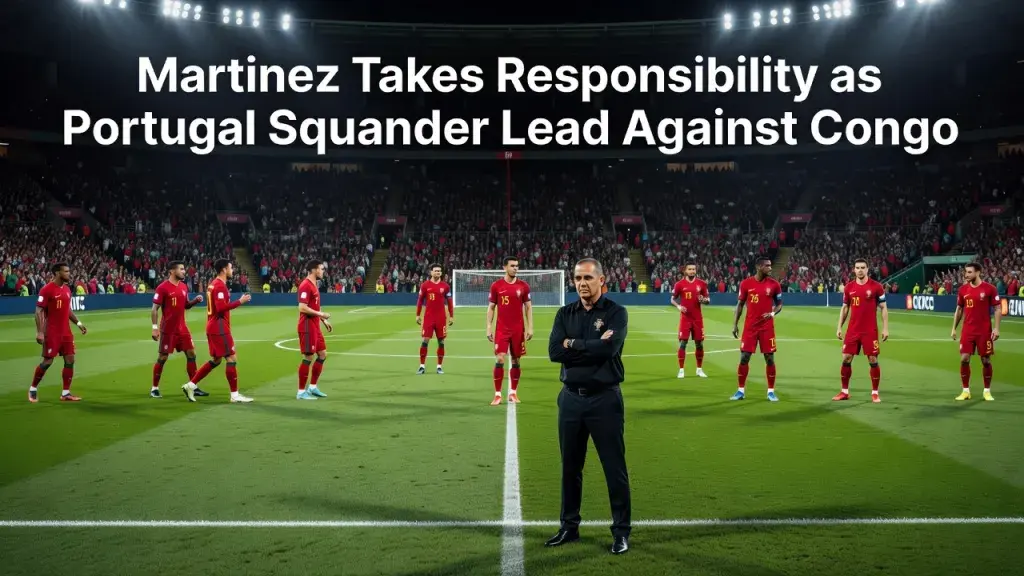
Roberto Martinez refused to hide behind excuses after Portugal were held to a draw by the Democratic Republic of Congo, a result that exposed a fundamental tactical flaw in the European side's approach: an unwillingness to push forward after taking the lead. Having broken the deadlock early, Portugal retreated into a possession-based holding pattern, allowing Congo to reorganize, regroup, and eventually find an equalizer. The manager was direct about where the fault lay.
"After scoring an early opening goal, normally the players would be energized and rush forward to score two more goals," Martinez said. "However, the Portuguese players controlled possession but only wanted to keep the ball safe. And then, the Democratic Republic of Congo had the opportunity to reorganize the game and they found an equalizer." The candor was admirable, but the problem itself was damaging. Portugal's 769 passes at a 93% accuracy rate told a story that statistics rarely capture: volume without ambition. Most of those passes went sideways or backward, and just as a sports enthusiast might browse niche markets like swedish floorball odds for something with actual movement and tempo, watching Portugal build possession without forward intent felt similarly disconnected from the main event. Cristiano Ronaldo, the focal point of the attack, received just two forward passes from teammates across the entire match that put him in a position to accelerate and threaten directly. Two.
The numbers from the first half were even more revealing. A full 85% of Portugal's passes were played in their own half and midfield - territory that wins no games and yields no pressure on an organized defensive block. This was not caution born of a tight scoreline or a difficult spell under pressure. It was the default mode of a team that appeared to believe keeping the ball was equivalent to controlling the game. It is not. Possession without penetration is noise, and Congo's players, organized and disciplined, were content to let Portugal make that noise indefinitely.
Congo's Defensive Structure Frustrated Every Portuguese Advance
Credit must be given to the Democratic Republic of Congo, who arrived with a clear and well-executed plan. Deploying a five-man defensive line, they ensured that central defenders Mbemba, Tuanzebe, and Kapuadi held their positions and provided no gaps for runners in behind. In front of them, a midfield trio of Mukau, Moutoussamy, and Kayembe maintained their shape with discipline, clogging the spaces through which Portugal would normally look to progress. Ronaldo was marked closely throughout, effectively removed from the game by design rather than by individual failings.
Congo made no secret of the fact that a draw would represent a strong result. That honesty informed their shape: compact, organized, and willing to absorb pressure without panic. When the pressure was horizontal rather than vertical - as Portugal's passing largely was - there was nothing to absorb. The African side simply waited, held their lines, and trusted that the opening would never come. They were right.
Martinez's Substitutions Improved Tempo, But Too Late and Too Individual
When Martinez introduced Rafael Leão and Francisco Conceição in the second half, Portugal's ball progression ratio relative to total passes did improve. The two attackers brought directness and a willingness to carry the ball forward that the starting lineup conspicuously lacked. But the improvement was built on individual quality rather than systemic change - moments of personal skill cutting through where collective movement had failed. That is not a sustainable formula, and it should concern Martinez heading into future fixtures.
The broader question this performance raises is one of identity and instruction. Portugal possess the technical quality to pass through teams at the highest level, but that quality requires the conviction to play forward, to commit runners, and to accept the risk that comes with ambition. On this occasion, caution overrode all of that. Martinez has identified the problem clearly and publicly. The more pressing task now is solving it - before opponents with greater quality than Congo are able to make Portugal pay a heavier price for the same mistake.